
22,50 €
eBook corresponds to the ISBN 978-3-9824267-8-5 / ISMN 979-0-9000199-0-5
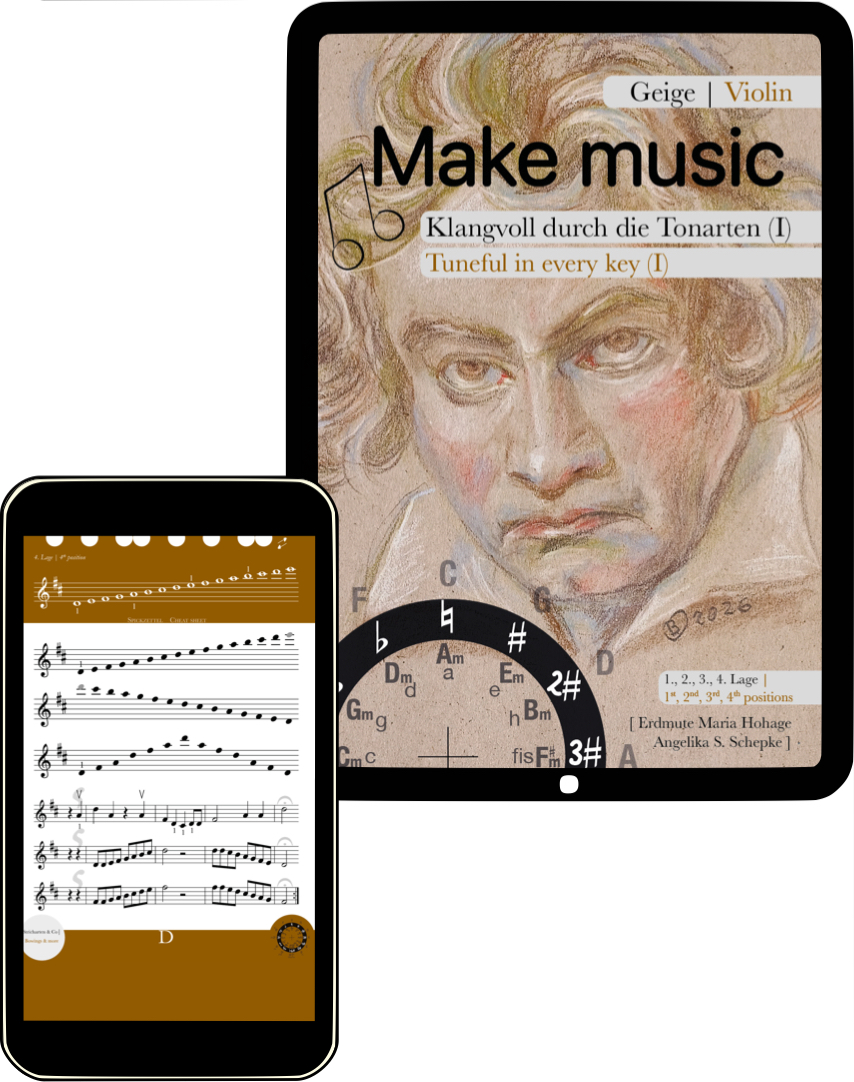
This supplementary volume in the Tuneful series for violin focuses on the systematic practice of scales and triads in a single position. The positions covered are 1st, 2nd, 3rd and 4th position. The volume contains:
Scales in all commonly used major and minor keys, including natural, harmonic and melodic minor
Major and minor triads
A canon for each key, inspired by Beethoven’s canon “Ich bitt’ dich”
Suggested bowing patterns and rhythmic variations for scales, triads and canons
The booklet is suitable for learners of all ages, from children to adults.
Further volumes and editions, more detailed information, as well as free teaching materials can be found on the dedicated topic page.
In addition to the opportunity to apply triads and scales in all keys directly to Beethoven’s music, almost all keys also offer the possibility of extending the position. This can include, for example, extending the 4th finger by a semitone, as well as extending the range beyond the tonic by adding further notes belonging to the key, either above or below.
These options are shown in grey notation, allowing them to be included or omitted according to the individual needs of the player.
Beethoven’s canon Ich bitt’ dich, schreib’ mir die Es-Scala auf was chosen as the basis because, in a concise form and with the possibility of playing in multiple parts, it allows the technique to be applied directly in musical context.
An accompanying eBook is available for teachers. It includes additional violin accompaniment parts for each of the individual keys, consisting mainly of thirds and sixths. For melodic minor,
an alternative accompaniment line that makes the characteristic changes between the ascending and descending forms easier to hear.
It also contains examples of how the canons can be varied or extended rhythmically.
Teachers can access all editions free of charge for review purposes. Further information can be found on the Make music topic page.
The eBook will not be delivered physically. It is available for download after successful registration (double opt-in confirmation of the e-mail address) and payment via the personal user account. For eBooks, the right of objection applies to the purchase of content on non-physical data carriers.